


NAVIGATING MID-SUMMER VOLATILITY: FOCUSING ON FUNDAMENTALS
Following a powerful rally in the first half of the year, markets experienced a mid-summer reset across July and early August. After tech and AI-focused stocks reached record highs, brief bouts of volatility and sector rotation emerged—leaving many investors wondering what steps to take next.
.
What Is Driving Market Movements?
While short-term pullbacks can feel uneasy, recent price swings reflect standard market digestion rather than a shift in broader economic health:
- Resilient Corporate Earnings: Beyond big tech, broad sector earnings—including industrials and infrastructure—continue to show solid fundamentals and healthy balance sheets.
- A Steady Federal Reserve: With inflation moderating, the Fed has held key rates steady. While policy paths create temporary yield shifts, corporate America continues to adapt well.
.
Balancing Volatility With Perspective
Market resets are a routine, healthy feature of financial markets. After rapid price gains earlier this summer, periods of profit-taking help normalize valuations and reduce overall risk. When short-term noise clears, core fundamentals like cash flow and revenue drive long-term value.
.
The Long-Term Takeaway
The most effective way to navigate market fluctuations is to stay grounded in your personal strategy:
1. Maintain Diversification: Ensure your portfolio spans asset classes aligned with your risk tolerance rather than concentrated momentum.
2. Focus on Cash Flow:Keep adequate liquidity in high-quality fixed income or cash equivalents to avoid selling equities during dips.
3. Stay Goal-Oriented:Short-term market headlines change daily, but long-term financial objectives remain fixed.
.
If recent market movements have raised questions about your portfolio alignment, let’s connect. We are always here to help you navigate changing conditions with clarity and confidence.

“It always seems impossible until it’s done.”
— Nelson Mandela
THE MONTH IN BRIEF
U.S. Markets
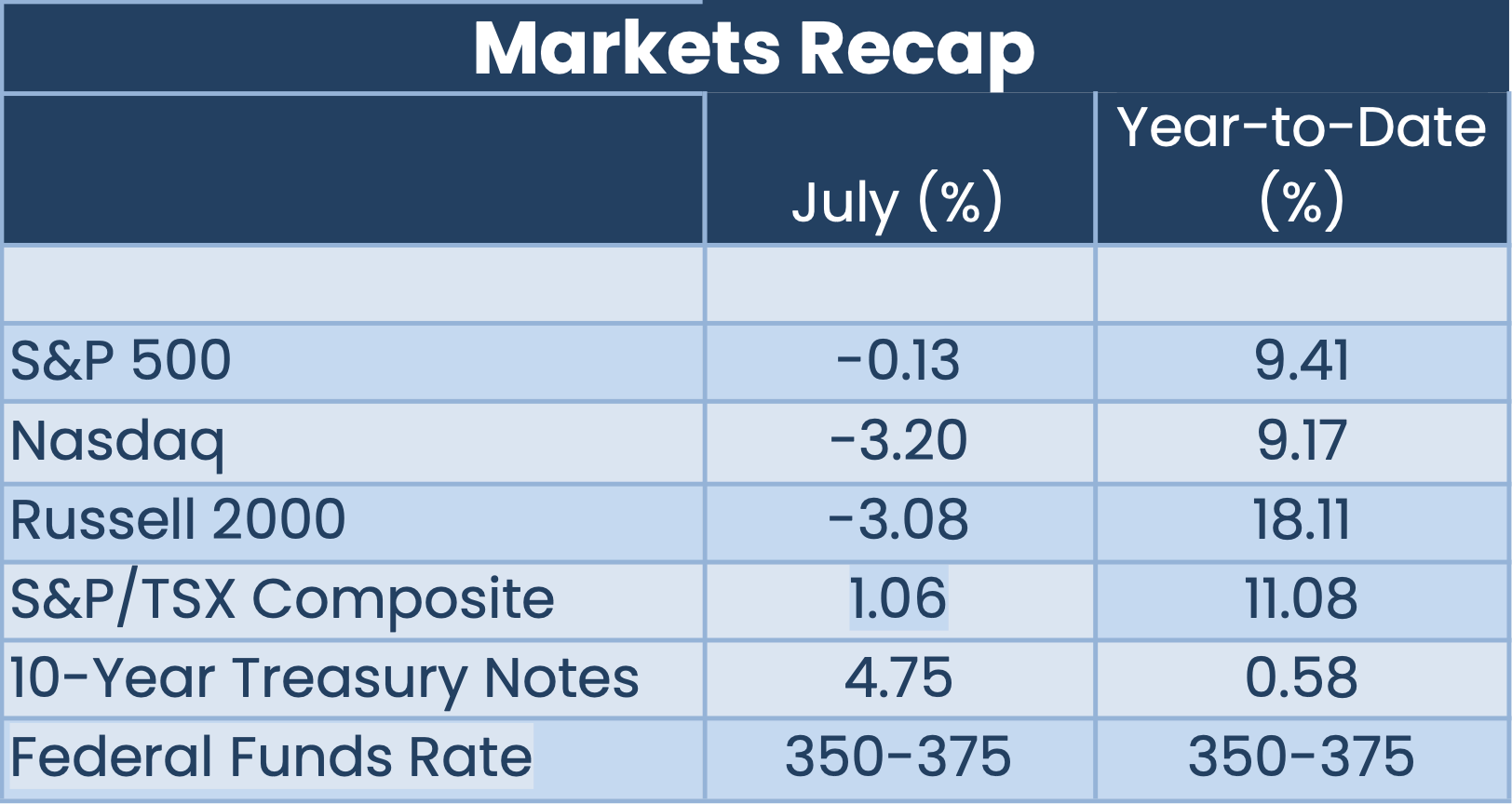
Stocks were mixed in July as investors navigated a cross-current of news on the outlook for AI spending and Q2 corporate reports.
The Dow Jones Industrial Average led, adding 0.32 percent. The Standard & Poor’s 500 Index edged down 0.13 percent, while the Nasdaq Composite lost 3.20 percent.1,2
1. WSJ.com, July 31, 2026
2. TMX.com, July 31, 2026
Advisory Services offered through Capital Analysts or Lincoln Investment, Registered Investment Advisers. Securities offered through Lincoln Investment, Broker/Dealer Member FINRA/SIPC. www.lincolninvestment.com M3 Investment Services and the above firms are independent and non-affiliated.
The views and opinions expressed herein are those of the author(s) noted and may or may not represent the views of Lincoln Investment. These views are as of August 10, 2026 and are subject to change based on subsequent developments. The material presented is provided for informational purposes only. Information is based on sources believed to be reliable; however, their accuracy or completeness cannot be guaranteed. Nothing contained herein should be construed as a recommendation to buy or sell any securities. As with all investments, past performance is no guarantee of future results. No person or system can predict the market. All investments are subject to risk, including the risk of principal loss. S&P 500 Index is an index of 500 of the largest exchange-traded stocks in the US from a broad range of industries whose collective performance mirrors the overall stock market. The Dow Jones Industrial Average is a widely watched index of 30 American stocks thought to represent the pulse of the American economy and markets. The NASDAQ is an index that tracks the cumulative results on a market capitalization basis of all stocks trading in the NASDAQ system. The S&P/TSX Composite Index is the benchmark Canadian stock market index representing roughly 70% of the total market capitalization of the Toronto Stock Exchange. Investors cannot invest directly in an index. Past performance is no guarantee of future results. 8/26